The morning peak, the plateau, the evening
The loudest hours are the morning and evening peaks — and the evening one is exactly when you want to be in the garden. Overnight the road quietens, but night-time noise carries a ten-decibel penalty in the standards, because that is when it does the most harm. That weighting is what Lden is, and it is why one daytime figure misleads.
Day and night, on one scale
Illustrative day — the report plots your address
Hear it before you buy
A simulation of your property, so fifty-eight decibels stops being an abstraction and becomes something you have actually heard. Plus an aerial view with the noise mapped over your plot — road, boundary and house — showing where the quiet actually is.
What’s included
- Everything in the Noise Risk Report
- Audio simulation — hear it before you buy
- Aerial view with noise overlay
- 24-hour ‘day in the life’ profile
- Shareable report link
Noise Insight Report
The whole day, not one number
Hear my property →What this is — and what it isn't
- Automated and modelled — produced by our software from national datasets, not measured at your property.
- No site visit and no individual human review of your report.
- Every report states its uncertainty range. Figures are estimates within that range.
- Not suitable as the sole or primary evidence for a planning application or appeal, legal proceedings, an insurance claim, or anything else needing a precise measured level.
- In a purchase or price negotiation it is supporting context for your own decision — not a valuation, and not a measured figure the other side has to accept.
If you need a figure that will stand up for planning, a legal dispute or an insurance claim, you need a measured survey by a qualified acoustic consultant — not this report. We will tell you that rather than sell you the wrong thing.
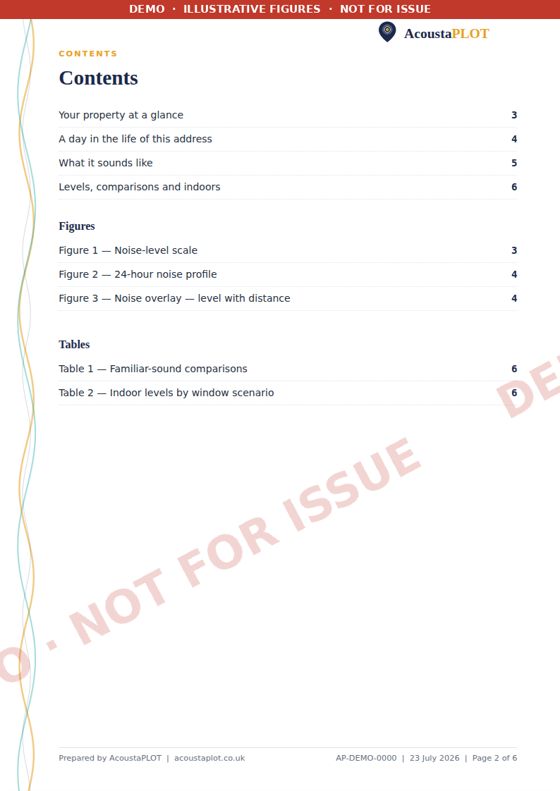
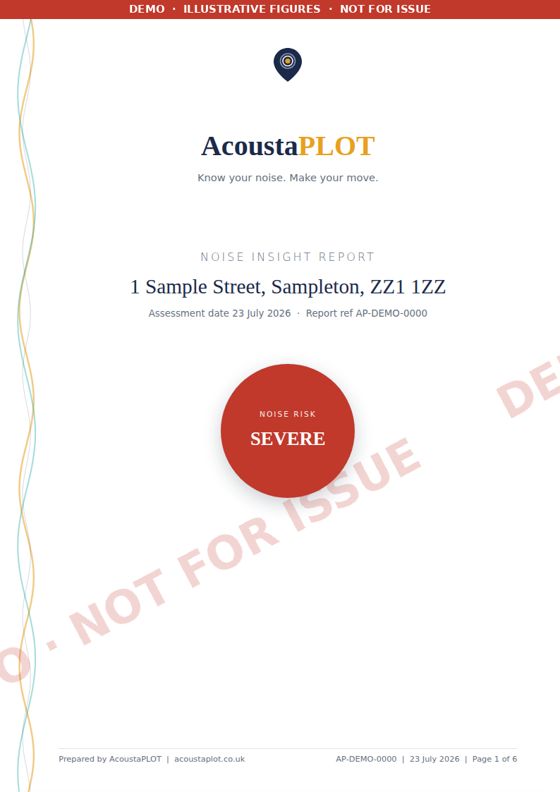
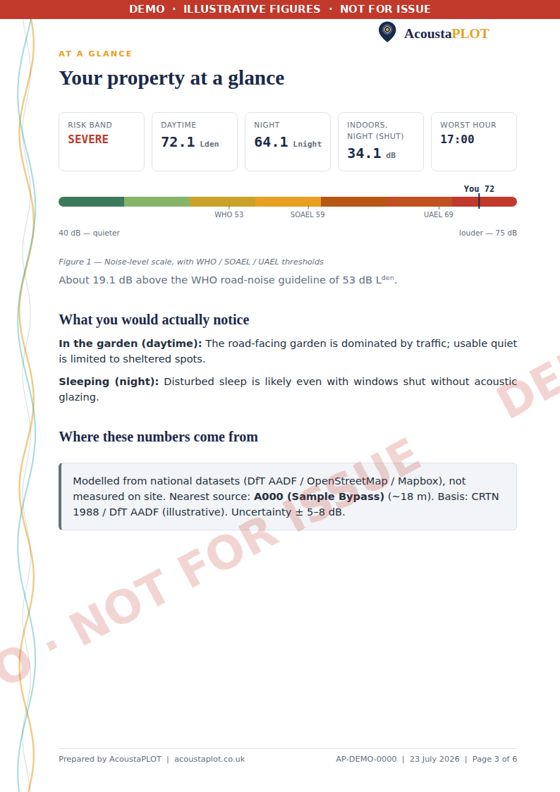
Demo pages from a fictional sample property — not a real assessment
The demo Insight report, page by page — watermarked, illustrative figures
Built on the national datasets
Modelled from national datasets with the standard UK methods — and labelled as modelled, always.
Questions listeners ask
How is the audio simulation made?
It is synthesised from your property's modelled level and source mix — real road character, not white noise — so the number becomes something you have actually heard at a calibrated playback level.
Is the 24-hour profile my road's real traffic?
It is built from the modelled flow for your dominant source, shaped by the standard diurnal pattern for that road class. Where a DfT count point sits near your road, real counted traffic anchors it — and the report labels which applies.
What does Lden actually mean?
It is the day-evening-night level: a 24-hour average that adds a 5 dB penalty to evening noise and 10 dB to night noise, because noise harms sleep more than it harms lunch. It is the number the standards weigh — and why one daytime reading misleads.
Can I send the result to someone else?
Yes — this tier includes a shareable link, made for partners, agents and solicitors. The PDF is yours to keep and forward.
An offer-ready, one-page price-context document to hand to your agent or solicitor.
Every AcoustaPLOT report is a desktop model — fast, honest about its uncertainty, and the right tool before a decision. Where a figure must stand up formally, for planning or a dispute, the route is an on-site measured survey by a qualified acoustician. How that works →
ISO 9613-2 barrier design · Modelled fence height / length / position · Interactive model + acoustic-shadow visual.