Know your road and rail noise.
Make your move.
A plain-English assessment of road and rail noise, in under a minute, for any address in England — built from the same national datasets that inform government planning policy.
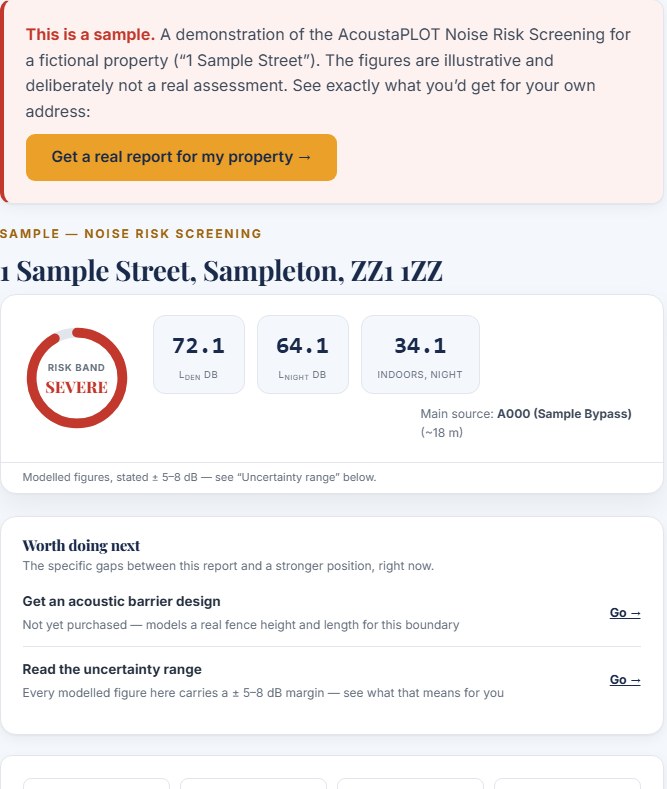
A real report screen, shown with a fictional sample property — not a live assessment.
What brings you here?
Buying or renting?
Check if an address is noisy before you commit to it.
Check if it's noisy →Already dealing with noise?
See if a fence or barrier would actually help — and what it would take.
See if a fence would help →Trade & professional
Surveyors, agents and developers — bulk pricing and a dedicated licence.
See trade options →A fence only works if it's built to.
To cut road noise a barrier has to do three things: be solid and gap-free, be tall enough to block the line of sight to the road, and be long enough that sound can't slip around the ends. Miss one — as many garden fences do — and you'll barely notice. Get all three right and a real pocket of quiet opens up.
Every assessment starts by dropping a pin.
Not a postcode average, not a rough area estimate — an exact point on your actual plot, so every figure that follows is calculated for the ground you're standing on.
- ✓Pinpoint location, not postcode-level guesswork
- ✓The same pin anchors every dataset — terrain, traffic, noise
- ✓Move it before you buy the report; nothing's locked in early
The model keeps moving behind every report.
Every report is modelled for your plot — DfT traffic counts, Defra rail noise mapping and elevation data wherever they cover it — not a generic postcode average. Warm is loud, cool is quiet, every metre from the road to your back fence, so you'll see where a barrier is modelled to carve out real quiet before you commit.
From blueprint, to real fence, to the noise falling on it.
A real render from the modelling pipeline — the wireframe becomes the photoreal barrier, then the ground shows what it's actually blocking.
Three steps to a clear answer
Enter your address
Type your postcode or full address. AcoustaPLOT locates your property and every road and railway line within range that could affect your noise environment.
We run the data
Our engine pulls DfT traffic flows, Defra noise mapping and elevation data wherever they cover your location and runs the full acoustic model — in seconds.
Get your report
A clear, plain-English report: your estimated level, what it means for health and amenity, and what your options are. No acoustic jargon. No waffle.
Play the road before you buy.
On Insight and above, we turn the numbers into sound. Hear an illustrative version of your road — traffic, not white noise — day and night, before and after a barrier. It's a relative comparison, not a calibrated playback: your device's own volume sets the absolute level, not us.
The same national data government planning uses.
No guesswork dressed up as data. Every assessment is built from official national datasets, and where one doesn't cover your address the report says what it assumed instead.
National LIDAR
Laser-scanned ground heights at 1 metre resolution — the measured shape of your land, hills, cuttings and embankments that decide how sound travels.
OS Terrain
Britain's national mapping backbone — used to locate your property precisely and to fill ground detail wherever LIDAR doesn't reach.
Strategic noise maps
England's official road and rail noise maps — the same evidence base that informs national planning and noise policy.
Traffic counts
Real measured vehicle flows on the roads near you — cars, HGVs and speeds — so the noise we model reflects your actual road, not an average.
Choose the level of detail you need
Screening
- Noise risk band for your address
- Lden & Lnight at your property
Complete
- Everything in Barrier Design
- Mitigation options plan with indicative costs
What this is — and what it isn't: Automated and modelled — produced by our software from national datasets, not measured at your property. No site visit and no individual human review of your report. Every report states its uncertainty range. Figures are estimates within that range. Not suitable as the sole or primary evidence for a planning application or appeal, legal proceedings, an insurance claim, or anything else needing a precise measured level. In a purchase or price negotiation it is supporting context for your own decision — not a valuation, and not a measured figure the other side has to accept.
All prices are the total you pay — no VAT added, nothing further to pay on delivery.
Check our working, not someone else's five stars.
We're new enough that we don't have a page of reviews to show you yet, and we'd rather say that plainly than fill the space with something else. What's here instead: a full published methodology, a stated modelling uncertainty on every result, and a clear list of what the report can't tell you. When real customer reviews exist, they'll be published here unedited — the critical ones too.
Common questions
Is this a real acoustic assessment or just a rough guide?
What areas does AcoustaPLOT cover?
How long does the report take?
Is my payment secure?
Can I use this report for a planning application?
My problem is a noisy neighbour, not traffic — can AcoustaPLOT help?
How do I know an email claiming to be from AcoustaPLOT is genuine?
Can I use this to check workplace or staff noise exposure?
What if my address isn't found, or my house is a new build?
The result doesn't match what I expected — can I query it?
Does the assessment know exactly where my house sits, or just the general area?
My property is affected by both a road and a railway — which number do I get?
Can I show this report to a mortgage lender or solicitor?
Know before you view.
Know before you buy.
Get a plain-English noise risk assessment for your property in under a minute.